
Clare Criminal History Checks
A Clare criminal record search works best when the incident address comes first. The Clare Police Department holds reports created by its officers. A report may describe the call, statements, evidence, and the charge considered at the time. It is not the same record as a jail booking or a court case. If the event occurred on the Isabella County side, detention and court records follow the Isabella chain. An event across the line can lead to Clare County instead.
Gather the person’s correct name, birth year, incident date, location, and any CPD complaint number before searching. Those details help the police locate a report and help a court distinguish similar names.
- Confirm the street or place where the Clare event occurred and identify the county side.
- Use the Clare police FOIA form for the city incident report or ask the police counter which record exists.
- Check the correct county jail channel if the person was booked and held.
- Search the matching District Court, then the Circuit Court if a felony was bound over.
- Use Michigan ICHAT only when a statewide public repository result serves the question.
Clare Records Cross a County Line
The city’s boundary is the key local trap. Clare’s 2020 whole-city population was 3,254, but that number cannot be described as an Isabella-only count. The same care applies to criminal records. An Isabella-side Clare arrest can enter the Isabella County Criminal Justice Center and the 76th District Court. A Clare County-side event follows the 80th District Court and Clare County custody chain. Searching only one court may miss a valid case from the other side.
Police agency totals need the same label discipline. Clare Police Department data covers its cross-county service area. It is not sound to call those figures “Isabella County Clare crime.” For a record tied to one event, use the address in the report, booking, citation, or complaint to pick the right county. If the location is unclear, ask CPD before ordering court copies.
Note: A whole-city population or police total does not become an Isabella County figure merely because Clare has an Isabella-side area.
Records at the Clare Police Department
The Clare Police Department operates from the Public Safety Building at 207 W Fifth Street, Clare, Michigan 48617. Its published phone is 989-424-4075 and fax is 989-386-4508. The department reports that officers are on duty around the clock. Chief David Saad is listed at dsaad@cityofclare.gov, while CPD.Tips@cityofclare.gov is the nonemergency tip route. A tip is not a request for a copy of an existing police record.
The department publishes forms for FOIA requests, voluntary statements, identity-theft or fraud matters, abandoned vehicles, vacation checks, bicycle registration, and business contacts. Crash reports use the official portal linked by CPD. These channels serve different tasks, so a requester should not use a tip or report-submission route to seek an old record.
The official Clare police page shows the department and its record services.
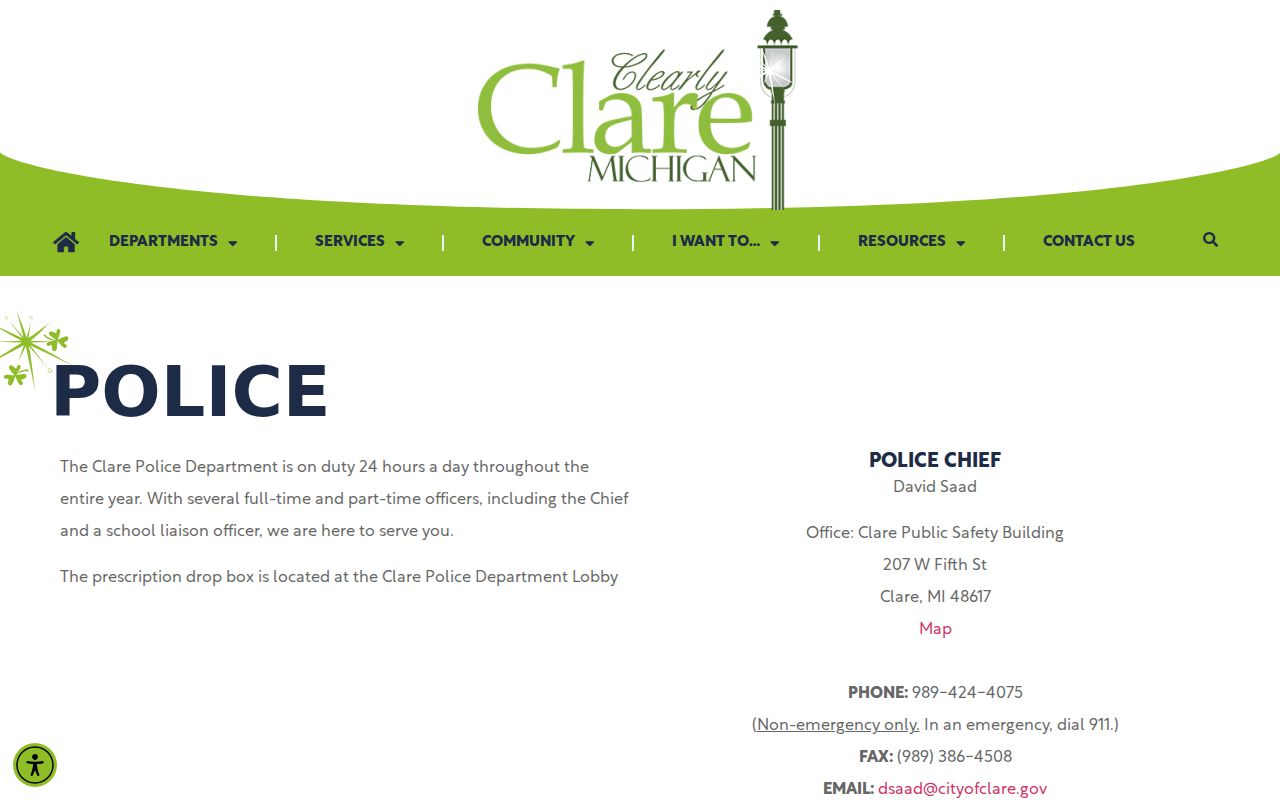
The department page is the best place to confirm a current counter contact before a visit.
Inside Clare’s Police FOIA Form
The Clare online police FOIA form asks for enough detail to locate a specific existing record. It requires the requester’s name, birth year, street, city, state, ZIP, daytime phone, and email. Event details include the date and time, incident type, location, and a description of the records sought. The CPD complaint number is optional, but adding it can reduce ambiguity.
The form also asks whether the requester wants inspection or copying. A “True Copy” box is optional. The city does not have to create a new account, answer research questions, or make a recording that never existed. A narrow request for named records is more useful than a demand for everything about a person.
| Form field | Entry | Rule |
|---|---|---|
| Name and birth year | Text | Required |
| Address, phone, email | Contact fields | Required |
| Incident date, time, type, location | Event details | Required |
| CPD complaint number | Text | Optional |
| Records requested | Long text | Required |
| Inspection or copying | Choice | Select one |
| True Copy | Checkbox | Optional |
The official form illustrates how Clare criminal records requests are described before submission.
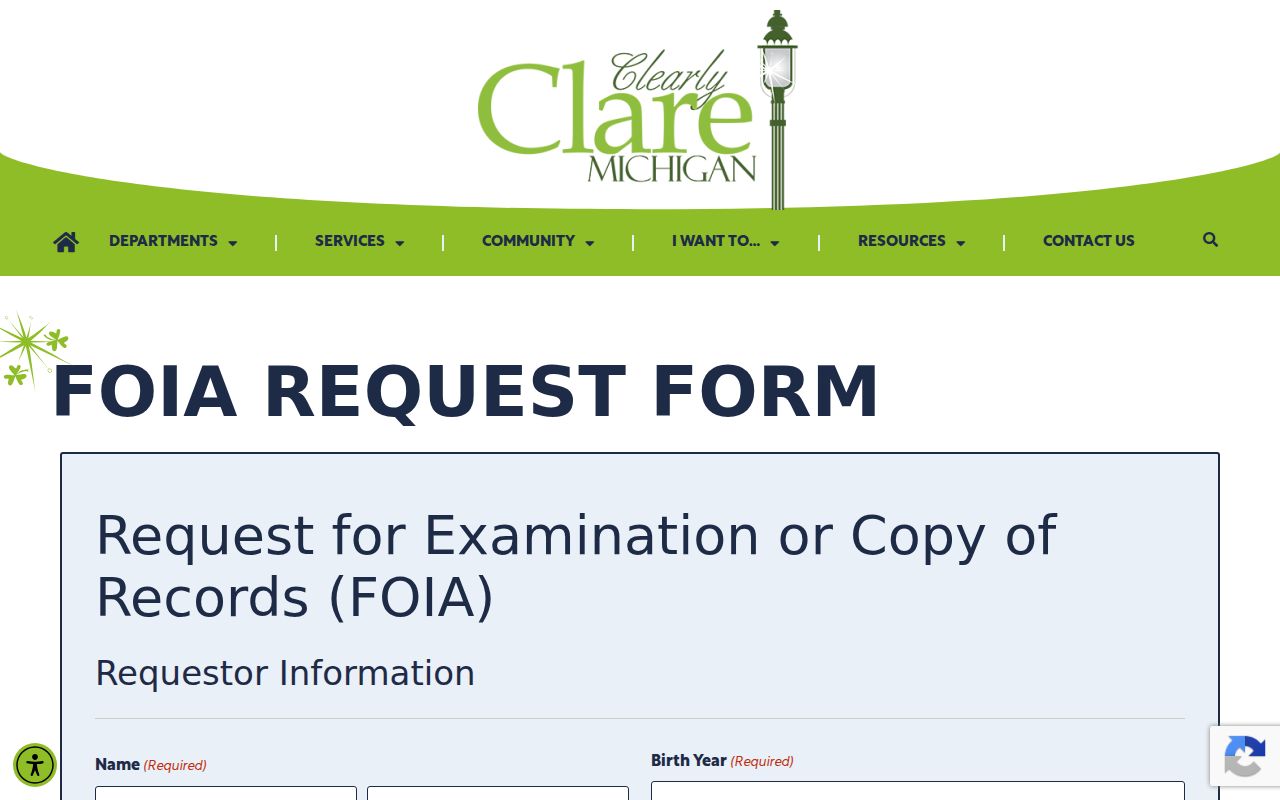
Its field set helps a requester prepare the event facts before choosing inspection or copies.
Booking and Arrest Records in Clare
Clare has no long-term city jail roster. When a CPD arrest occurs on the Isabella County side and detention is required, the person can enter Isabella County’s jail system. JailTracker is the county’s current-custody tool, and the jail information line provides a fallback when a current result is unclear. A released person may no longer appear in a live custody view even though the police report or court file remains.
A booking charge is the allegation received at intake. The prosecutor may authorize a different charge, decline it, or file no case. That is why a Clare arrest search should continue to the correct court. On the Isabella side, all adult criminal matters begin in D76. A felony moves to C21 only after the preliminary stage and bindover. The city police report stays with CPD throughout that path.
Trace an Isabella-Side Clare Arrest
For an Isabella-side event, first request the CPD narrative. Next, check the county’s official JailTracker gateway for current custody. Then search the 76th District Court in MiCOURT for the filed misdemeanor or first felony stages. If the docket shows a felony bindover, search the 21st Circuit Court too. The county court file may show charges, hearing events, pleas, disposition, and sentence, but it will not replace the officer’s narrative.
This sequence also explains why three systems can disagree for a time. A police report reflects the investigation. Jail data reflects custody. The docket reflects the charge the prosecutor filed. For broader reportable Michigan history, ICHAT adds a state repository view, but it excludes warrants, juvenile records, federal and tribal matters, traffic records, and some local misdemeanors.
The Clare Municipal Court File
Clare does not operate a municipal court or a single city case lookup. Court jurisdiction turns on the incident location. Isabella-side adult cases start in the 76th District Court, while a felony can continue in the 21st Circuit Court. Clare County-side cases use that county’s court chain. A city FOIA request cannot produce either court’s pleadings or certified docket.
| Court Name | No Clare municipal court; use the county court with geographic jurisdiction. |
|---|---|
| Case Types Heard | D76 handles Isabella-side misdemeanors and felony preliminary stages; C21 hears a felony after bindover. |
| Case Lookup Channel | MiCOURT for Isabella D76 and C21, followed by the clerk for the official file. |
| What the Docket Shows | Case number, filed charge, events, status, hearings, disposition, and judge where publicly displayed. |
| Copies and Fees | Ask the responsible clerk for current copy and certification terms; no Clare city court fee applies. |
Clare Video May Not Still Exist
A June 2025 official city packet gives a useful, dated example of retention limits. It said exterior police video was managed by a vendor and was not retained by the city unless staff retrieved and preserved it for an investigation or formal complaint. The ordinary overwrite period was described as about one month, depending on motion and data volume. That statement is not a promise about every camera or today’s exact schedule.
The practical point is firm: Michigan FOIA reaches existing records. It does not force Clare to create footage or recover data that was not kept. Ask for a defined camera, place, date, and time as soon as possible, and ask whether preservation occurred. A written denial, partial grant, or redacted release should identify its legal basis and appeal route.
How Clare Records Reach the County
Clare records do not merge into one city file. CPD creates the incident report. The correct county jail creates a booking if detention occurs. A prosecutor decides whether and what to charge. The court creates the docket and later reports a qualifying disposition to the Michigan State Police Criminal Justice Information Center.
Record flow: Clare Police Department › correct county jail and courts › Michigan State Police CJIC
A recent event may appear first in the police or custody channel. A filed case belongs at the court. ICHAT is useful for reportable Michigan history after data reaches the state repository, but it is not a live warrant list or a substitute for either county’s court file.
Clare Crash Reports Use a Separate Route
CPD links crash-report users to BuyCrash from its official police page. That route is distinct from the city’s general police FOIA form. Before ordering, match the event date, location, and report details. A crash report may document an incident without creating any criminal case. Conversely, an impaired-driving or other criminal allegation can generate both a police report and a court file.
Keep the source labels intact. The crash document comes from the police channel, while any charge or disposition must be checked with the proper court. The city’s lobby prescription drop box, bicycle registration, and other services do not change which custodian holds a criminal record.
Clare Police Records Reflect Reserve History
Clare has used reserve officers since the 1970s. The department’s current published description refers to a 28-hour reserve academy followed by field training. Reserve officers help with special events, parades, patrol, and other department work. That history adds useful context to an incident file because the name or role recorded in a report may reflect a reserve assignment rather than a separate police agency.
The custodian does not change. A Clare Police Department report remains a CPD record even when a reserve officer helped at the scene. Request it through the city police channel, then use the correct county court if the event produced a criminal charge. Do not infer that a reserve role makes a report less official, or that every event staffed by reserves led to an arrest.
This distinction also helps when searching old Clare records. Agency practices and staffing labels can change over time, while the event date controls which record series and retention rule may apply. Give the city a narrow date range, location, and report type. If a court case followed, search the docket under the defendant’s name and the county side where the incident occurred.
Clare Record Access Rules
The Michigan Freedom of Information Act governs access to sufficiently described existing city records, subject to exemptions and lawful fees. Active investigative material, juvenile information, victim-identifying data, and security-sensitive content can be withheld or redacted. Court files follow judicial access rules rather than a Clare city FOIA. Nonpublic set-aside records remain restricted under state law.
Key statutes:
Michigan Freedom of Information Act, MCL 15.231–15.246 allows requests for identifiable existing public-body records, with exemptions and fees.
MCL 780.621d sets application waiting periods and required statements for eligible conviction set-asides.
MCL 28.721 et seq. governs Michigan sex-offender registration and public registry duties.
Clare Records Stop at Agency Lines
A Clare FOIA request reaches Clare city records only. It does not compel the Isabella Sheriff, Mount Pleasant Police, CMU Police, Tribal Police, MSP, or a court to release files held by those offices. That boundary matters when a person moved through more than one agency. Send a separate request to each custodian that created the record.
The CMU Police records page shows how another local agency keeps its own request route.
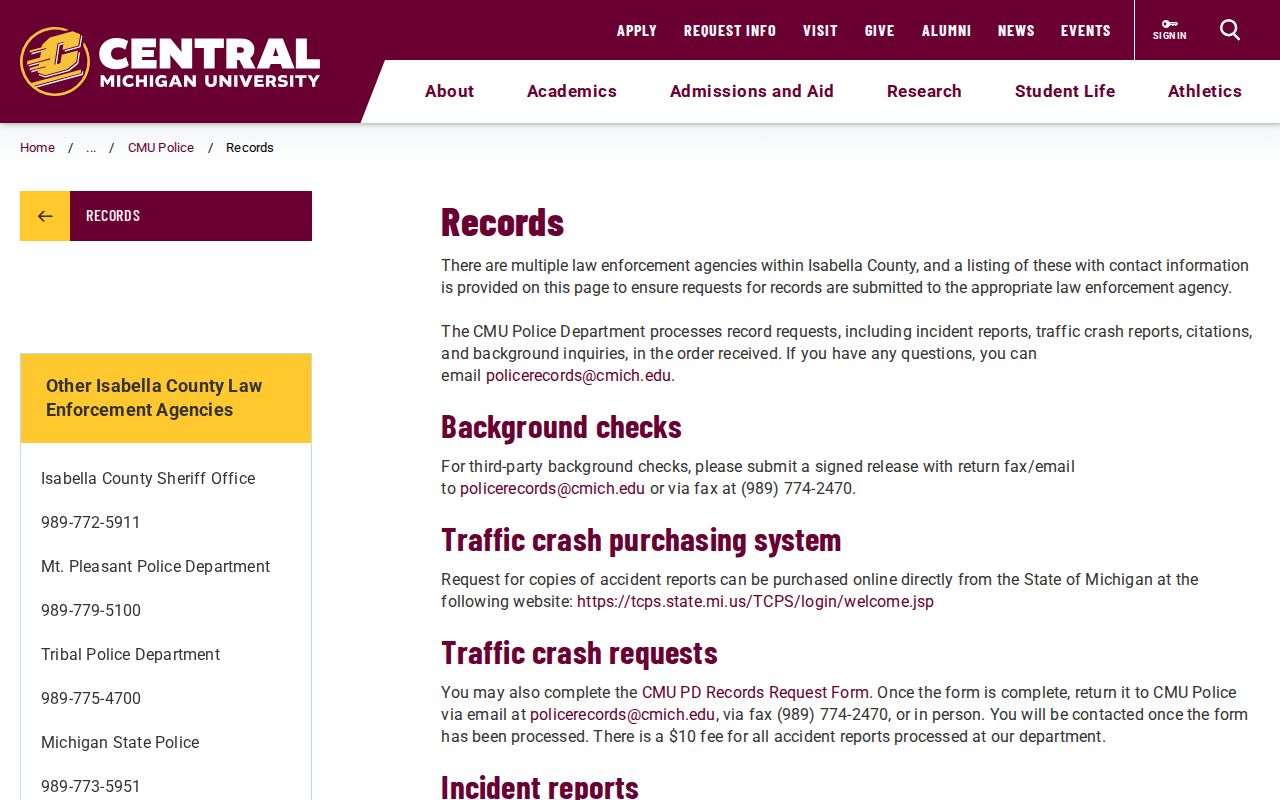
The separate CMU channel reinforces why no single city request gathers every Isabella-area police report.